jueves, 15 de noviembre de 2012

The Past Perfect Continuous

Past Perfect Continuous Tense:
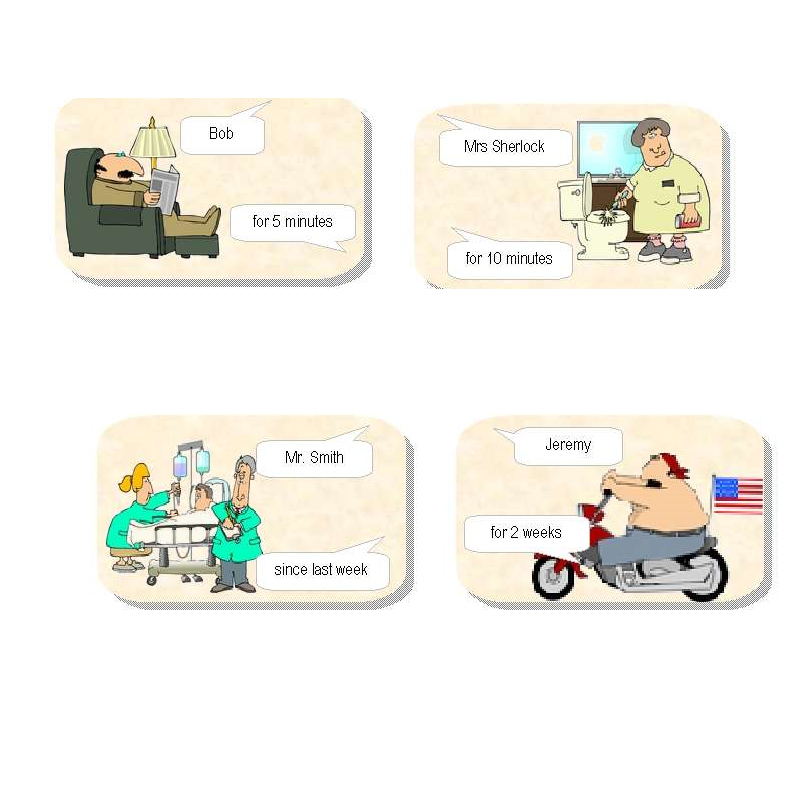
Here's how to make the past perfect continuous. It's 'had' + been (the past participle of 'be')+ verb-ing
Firstly, let's look at the positive form:
  • I had been living
  • You had been going
  • She had been sleeping
  • He had been working
  • It had been raining
  • We had been studying
  • They had been cooking
The short form is: 'd been verb-ing. Be careful, because the short form for 'would' is also 'd. However, 'would' is always followed by the infinitive, but 'had' is followed by the past participle.


Next, the negative form:
  • I had not been trying (I hadn't been..)
  • You had not been working (you hadn't been..)
  • She had not been crying (she hadn't been..)
  • He had not been shopping (he hadn't been..)
  • It had not been snowing (it hadn't been..)
  • We had not been reading (we hadn't been..)
  • They had not been running (they hadn't been..)
It's pretty easy to make the question too.
'Yes / no' questions:
  • Had I been working?
  • Had you been sleeping?
  • Had she been reading?
  • Had he been watching TV?
  • Had it been raining?
  • Had we been drinking?
  • Had they been eating?
'Wh' questions:
  • Where had I been working?
  • How long had you been sleeping?
  • What had she been reading?
  • How long had he been watching TV?
  • How long had it been raining?
  • What had we been drinking?
  • Why had they been eating?

    Past Perfect Continuous Use:

    The past perfect continuous isn't the most common tense, but it's still useful to know.
  • Something that started in the past and continued up to another action or event (tells us 'how long')
    She had been working at that company for a year when she met James. (This tells us how long something had continued before another event in the past. We usually use 'for' or 'since' in the same way as we do with the present perfect continuous)
  • Cause of something in the past
    The pavement was wet, it had been raining. (It was raining before the time I'm describing in the past. We could see the result of the rain - compare with the present perfect continuous)

The Past Perfect

The past perfect Tense:

We don't use the past perfect a lot in English, but it is useful, and it sounds very good if you can use it correctly. Also, it's really easy to make - just the past simple of 'have' and the past participle.

The positive - make it with 'had' + the past participle (usually made by adding 'ed' to the infinitive, but a few verbs have irregular past participles):
(Also, here's some help if you are not sure how to pronounce '-ed' at the end of a verb).
  • I had been (I'd been)
  • You had gone (you'd gone)
  • She had met (she'd met)
  • He had played (he'd played)
  • It had rained (it'd rained)
  • We had bought (we'd bought)
  • They had studied (they'd studied)
The short form for 'had' is 'd.
(Be careful not to confuse it with 'would'. Would is followed by the infinitive - 'I'd go', whereas had is followed by the past participle - 'I'd gone').
For the negative just add 'not':
  • I had not been (I hadn't been)
  • You had not gone (you hadn't gone)
  • She had not met (she hadn't met)
  • He had not played (he hadn't played)
  • It had not rained (it hadn't rained)
  • We had not bought (we hadn't bought)
  • They had not studied (they hadn't studied).
And to make a 'yes / no' question put 'had' before the subject:
  • Had I come?
  • Had you eaten?
  • Had she gone?
  • Had it rained?
  • Had he studied?
  • Had we met?
  • Had they left?
For 'wh' questions put the question word at the beginning:
  • When had I come?
  • Why had you eaten?
  • Where had she gone?
  • When had it rained?
  • Why had he studied?
  • How had we met?
  • When had they left?

Past Perfect Use:

We use the past perfect tense fairly often in English.

1: A completed action before something else in the past.
  • When we arrived, the film had started. (= first the film started, then later we arrived)
2: To explain or give a reason for something in the past.
  • I'd eaten dinner so I wasn't hungry.
  • It had snowed in the night, so the bus didn't arrive.
3: Stative verbs only: something that started in the past and continued up to another action in the past.

  • When he graduated, he had been in London for six years.

    (= he arrived in London six years before he graduated and lived there continuously until he graduated, or even longer)
4: As part of the third conditional.
 
If I had known you were ill, I would have visited you.

The Past Continuous

Past continuous Form:

(or past progressive tense)


How can we make the past continuous? Firstly, check that you know how to make the past simple with 'be' (subject + was / were). Then just add verb-ing.

 Here's the positive form:
  • I was sleeping
  • you were working
  • he was coming
  • she was reading 'War and Peace'
  • it was raining
  • we were shopping
  • they were watching a film
Next, here's the negative - it's very easy, just add 'not':
  • I was not (wasn't) sleeping
  • you were not (weren't) working
  • he was not (wasn't) coming
  • she was not (wasn't) reading 'War and Peace'
  • it was not (wasn't) raining
  • we were not (weren't) shopping
  • they were not (weren't) watching a film
And, just like the past simple with 'be', to make a 'yes / no' question, put 'was / were' in front of the subject:
  • Was I listening?
  • Were you working?
  • Was she working?
  • Was he living in Paris at the time?
  • Was it snowing when you arrived?
  • Were we eating?
  • Were they studying?
To make a 'wh' question (of course) put the question word at the beginning:
  • Why was I working?
  • Where were you living?
  • How was she travelling?
  • Where was he going?
  • Why was it snowing in the summer?
  • What were we eating?
  • Why were they studying?

Past Continuous Use:

The past continuous tense in English is used quite often, especially when telling stories.

1 A continuous action in the past which is interrupted by another action or a time:

I was taking a bath when the telephone rang.
At three o’clock, I was working.
2 Background information, to give atmosphere to a story:

It was a beautiful day. The birds were singing, the sun was shining and in the cafes people were laughing and chatting.
3 An annoying and repeated action in the past, usually with ‘always’:

He was always leaving the tap running.
(In the same way as the Present Continuous)
4 For two actions which happened at the same time in the past:

I was watching TV and he was reading.
NB:Remember you can’t use this tense or any continuous tense with stative verbs.


The Past Simple Tense

Past Simple Tense form:

(also called the simple past tense)

It's similar to the present simple because it has different rules for the verb 'be', which becomes 'was' or 'were':

The Past Simple with 'be'
Here's how to make the positive:
Positive with 'be'
I was cold                                                                                         
you were tired
he was in the garden
she was late
it was sunny
we were on holiday
they were hungry

 to make the negative with 'be', just add 'not': 

 Negative with 'be' Negative Short Form
I was not sleepy I wasn't sleepy
you were not on the bus you weren't on the bus
he was not at school he wasn't at school
she was not beautiful she wasn't beautiful
it was not cold it wasn't cold
we were not at work we weren't at work
they were not tired they weren't tired

To make a question, just like the present simple, we change the position of 'was / were' and the subject.
Here are the past simple 'yes / no' questions with 'be':

'Yes / No' Questions with 'Be'
was I sleepy?
were you late?
was he at the cinema?
was she kind?
was it hot?
were we hungry?
were they at work?
And the 'wh' questions with 'be' (the question word just goes at the beginning, everything else is the same):
'Wh' Questions with 'Be'
why was I sleepy?
where were you?
when was he at the cinema?
how was she?
how was it?
why were we hungry?
when were they at work?

The Past Simple (Simple Past) with Other Verbs

We make the past simple just like the present simple except we use 'did' instead of 'do / does'. It's really easy because 'did' doesn't change, even with 'he / she / it'.
The positive: 

We usually make the positive by adding '-ed' to the infinitive. For example, 'play' becomes 'played'. However, there are some irregular verbs, for example 'go' becomes 'went' and 'run' becomes 'ran'.
(Here's some help if you are not sure how to pronounce '-ed' at the end of a verb).
Positive with Other Verbs
I walked (regular)
you played (regular)
he cooked (regular)
she listened (regular)
it rained (regular)
we ate (irregular)
they drank (irregular)

In the negative there aren't any irregular verbs. All verbs use 'did not (didn't) + infinitive':
Negative               Negative Short Form
I did not walk I didn't walk
you did not play you didn't play
he did not cook he didn't cook
she did not listen she didn't listen
it did not rain it didn't rain
we did not eat we didn't eat
they did not drink they didn't drink

Questions are also very easy. Just put 'did' before the subject, and the infinitive after it.
Here are the 'yes / no' questions: 

'Yes / No' Questions
did I walk?
did you play?
did he cook?
did she listen?
did it rain?
did we eat?
did they drink?

To make a 'wh' question, of course, put the question word at the beginning of the sentence:
'Wh' Questions
where did I go?
what did you play?
what did he cook?
why did she listen?
when did it rain?
where did we eat?
how did they Travel?

Past Simple Use:

When do we need to use the past simple tense in English? Remember, this is the basic past tense. We use it whenever we want to talk about the past and we don't have any special situation that means we should use the past perfect, present perfect, past continuous etc.
Here's when we use it:
1 Finished events in the past with no connection to the present:

Leonardo painted the Mona Lisa.
The Vikings invaded Britain.
2 With a finished time word (yesterday, last week, at 2 o’clock, in 2003):

I went to the cinema yesterday.
We visited Japan in 2007.
3 For stories / lists of events:

He went to a café, sat down and lit a cigarette.
Yesterday I went to the library, met a friend for lunch, and played tennis.
4 Details of news:

I’ve hurt my leg. I fell off a ladder when I was painting my bedroom.
I've been on holiday. I went to Spain and Portugal.
5 As part of the second conditional:

If I won the lottery, I would buy a house in Chelsea.
If she knew his number, she would call him.


miércoles, 14 de noviembre de 2012

The Present Perfect Continuous

Present Perfect Continuous Form:

How good are you at the Present Perfect Continuous tense? It's not a very common tense, and often it's not taught in classes, but we do use it sometimes and it's very good to know how to make it, and to recognise it when other people use it.
Luckily, it's very easy to make. Here's the positive (it's the present perfect of 'be' + verb -ing):
Positive Positive Short Form
I have been walking I've been walking
you have been running you've been running
he has been cooking he's been cooking
she has been swimming she's been swimming
it has been raining it's been raining
we have been studying we've been studying
they have been sleeping they've been sleeping


To make the negative, just add 'not':
Negative Negative Short Form
I have not been walking I haven't been walking
you have not been running you haven't been running
he has not been cooking he hasn't been cooking
she has not been swimming she hasn't been swimming
it has not been raining it hasn't been raining
we have not been studying we haven't been studying
they have not been sleeping they haven't been sleeping


Can you guess how to make the question form of the present perfect continuous? It's not very difficult - just put 'have' or 'has' before the subject:

'Yes / No' Questions
have I been walking?
have you been running?
has he been cooking?
has she been swimming?
has it been raining?
have we been studying?
have they been sleeping?

For 'wh' questions put the question word first:

'Yes / No' Questions
what have I been doing?
where have you been running?
what has he been studying?
why has she been working today?
how long has it been raining?
how long have we been watching this film?

The Present Perfect Continuous Use:

(Also called The present perfect continuous Progressive)

Some people think the present perfect continuous is difficult to use, but really it's not very complicated, and it sounds very impressive when you use it correctly.
There are two main times we use this tense. Remember we can't use it with stative verbs.
1: To say how long for unfinished actions which started in the past and continue to the present. We often use this with for and since. (See the present perfect for the same use with stative verbs)
  • I’ve been living in London for two years.
  • She's been working here since 2004.
  • We've been waiting for the bus for hours.
2: Actions which have just stopped (though the whole action can be unfinished) and have a result, which we can often see, hear, or feel, in the present (focus on action). (See the present perfect for a similar use which focuses on the result of the action)
  • I’m so tired, I’ve been studying.
  • I've been running, so I'm really hot.
  • It's been raining, the pavement is wet.
  • I've been reading your book, it's very good.


The Present Perfect


Present Perfect Form:

To make the positive present perfect tense, use:
  • 'have' / 'has' + the past participle
  • Make the past participle by adding 'ed' to regular verbs (for example, 'play' becomes 'played')
  • There are a few verbs that change their spelling when you add 'ed' (for example, 'study' becomes 'studied')
  • We also have some completely irregular verbs.

Positive Positive Short Form
I have played I've played
you have worked you've worked
he has written he's written
she has walked she's walked
it has rained it's rained
we have travelled we've travelled
they have studied they've studied


The negative is really simple too. Just put 'not' after 'have' or 'has':
Negative Negative Short Form
I have not eaten breakfast today I haven't eaten
you have not been to Asia you haven't been
he has not seen the new film he hasn't seen
she has not played tennis she hasn't played
it has not snowed this winter it hasn't snowed
we have not slept all night we haven't slept
they have not tried the food they haven't tried


To make a question, put 'have' or 'has' in front of the subject:
'Yes / No' Questions
have I missed the bus?
have you visited London?
has he worked as a waiter before?
has she met John?
has it been cold this week?
have we arrived too early?
have they studied English grammar before?

As you can imagine, for 'wh' questions, we just put the question word before 'have' or 'has':
'Wh' Questions
where have I left my umbrella?
what have you done today?
why has he gone already?
where has she been in the UK?
why has it rained so much this summer?
what have we done?
where have they learned English before?

 Present Perfect Use:

We use this tense for unfinished and finished actions:

Unfinished Actions
We use this tense when we want to talk about unfinished actions that started in the past and continue to the present. Usually we use it to say 'how long' an action or state has continued with 'since' and 'for'. Often, we use stative verbs in this situation:
  • I’ve known Karen since 1994.
  • She's lived in London for three years.
'Since' and 'For'
We use 'since' with a fixed time in the past (2004, April 23rd, last year, two hours ago). The fixed time can be another action, indicated with the past simple (since I was at school, since I arrived):
  • I've known Sam since 1992.
  • I've liked chocolate since I was a child.
  • She's been here since 2pm.
We use 'for' with a period of time (2 hours, three years, six months):
  • I've known Julie for ten years.
  • I've been hungry for hours.
  • She's had a cold for a week.
Finished Actions
1: life experience
(we don't say when the experience happened, just sometime in the past)
  • I have been to Tokyo.
  • She has lived in Germany.
  • They have visited Paris three times.
  • We have never seen that film.
  • Have you ever read 'War and Peace'?
2: a finished action with a result in the present (focus on result)
  • I’ve lost my keys (so I can’t get into my house)
  • She's hurt her leg (so she can't play tennis today)
  • They've missed the bus (so they will be late)
  • I've cooked dinner (so you should come and eat)
3: with an unfinished time word (this month, this week, today, in the last year)
  • I haven't seen her this month.
  • She's drunk three cups of coffee today.
  • This week they've been shopping four times.
Note: We can’t use the present perfect with a finished time word:
(NOT) I’ve seen him yesterday.
'Been' and 'Gone'
In this tense, we use both 'been' and 'gone' as the past participle of 'go', but in slightly different circumstances.
Been
We use 'been' (often when we talk about 'life experience') to mean that the person being talked about has visited the place, and come back. Notice the preposition 'to':
  • I've been to Paris (in my life, but now I'm in London, where I live)
  • She has been to school today (but now she's back at home)
  • They have never been to California.
Gone
We use 'gone' (often when we are talking about an action with a result in the present) to mean that the person is at the place now:
  • 'Where's John?' 'He's gone to the shops' (he's at the shops now)
  • Julie has gone to Mexico (now she's in Mexico)
  • They've gone to Japan for three weeks (now they're in Japan)


Present Continuous

 Present Continuous Form

The present continuous (sometimes called the present progressive) tense in English is really easy to make and is the same for all verbs. We make it using the present simple of be+ verb-ing:

Here is how we make the positive:
Positive   Positive Short Form
I am sleeping I'm sleeping
you are sleeping you're sleeping
he is sleeping he's sleeping
she is sleeping she's sleeping
it is sleeping it's sleeping
we are sleeping we're sleeping
they are sleeping they're sleeping


We can make the negative by adding ‘not’:
Negative Negative Short Form
I am not sleeping I'm not sleeping
you are not playing you aren't playing
he is not reading he isn't reading
she is not working she isn't working
it is not raining it isn't raining
we are not cooking we aren't cooking
they are not listening they aren't listening


Questions are also really, really easy. Just like we made the question with ‘be’ in the present simple, here we also put ‘am’, ‘is’, or ‘are’ before the subject to make a 'yes / no' question:

Yes / No Questions
am I eating chocolate ?
are you studying now ?
is he working ?
is she doing her homework ?
is it raining ?
are we meeting at six ?
are they coming ?


For ‘wh’ questions, just put the question word at the front:

Wh Questions
Why am I eating chocolate ?
What are you studying now ?
When is he working ?
What is she doing ?
Why is it raining ?
Who are we meeting ?

Present continuous Use:

Now you can make the present continous tenses. But what about present continuous use? Here are some situations when we need this tense. look 4 examples:

1: we use it for things that are happening at the moment of speaking.
  • I’m working at the moment.
  • Please call back – we are eating dinner.
  • Julie is sleeping.
  • You are studying the present continuous.
2: We can also use this tense for temporary situations, when we feel something won't continue for a long time.
  • She’s staying with her friend for a week.
  • I’m living in London for a few months.
  • John’s working in a bar until he finds a job in his field.
  • I’m reading a really great book.

Compare this with the present simple, which is used for permanent situations that we feel will continue for a long time.

3: We can use the present continuous for habits but they have to be temporary or new habits (for normal habits that continue for a long time, we use the present simple).
  • He’s eating a lot these days.
  • She’s swimming every morning (she didn’t used to do this).
  • You’re smoking too much.
  • They’re working late every night.
4: Another present continuous use is for annoying habits, when we want to show that something happens too often and we don't like it. In this case we need to use an adverb like ‘always’ / ‘forever’ / ‘constantly'.
  • You’re always losing your keys!
  • She’s constantly missing the train.
  • He’s always sleeping in.
  • They’re forever being late.